HOW DO FEDERAL ADA SIGNAGE REQUIREMENTS APPLY TO CALIFORNIA RESTROOM SIGNS?
Federal ADA sign requirements dictate that restrooms be identified with tactile signage complying with §703 of the 2010 Standards for Accessible Design (SAD). Additionally, if not all restrooms in your building are accessible as defined in section §603, then signs directing toward the nearest accessible restroom must be posted and the ISA must on signs to identify accessible restrooms. Directional signs must be ADA visual character compliant, as defined in §703.5. This SAD section defines additional font, size and contrast signage requirements, and Green Dot ADA signs meet all regulations.
To summarize, you need a tactile wall sign in addition to your Title 24 door sign. If not every bathroom is accessible, then you must post signs directing to the accessible bathrooms and use signs with the ISA to identify accessible restrooms. It’s usually easiest to include the ISA on the tactile, wall mounted restroom sign.
This decision matrix summarizes overlapping California and federal ADA restroom sign requirements regarding accessibility and dual purpose tactile and geometric signage.
For commercial buildings, it is best practice to include the ISA on restroom signs regardless of whether it’s technically required.


Can my CA Title 24 geometric door sign also be the federally required ADA compliant tactile sign, so that I only need one sign?
Yes, in very limited cases you can combine federal tactile ADA and California Title 24 restroom signs. It’s never recommended unless the bathroom entry doesn’t have a door.
Best practices dictate having two separate restroom signs: 1. a CA Title 24 geometric door sign without tactile characters and 2. a federally ADA compliant tactile wall sign.
If your door meets all of the following requirements you can consider combining your signs: 1. sign must be on push side of door, 2. door may not have a hold open device and 3. door must have an automatic closing device.
Note that “push side of door” means the door may not push open in both directions. The door must be push – pull in one direction only.
While a single sign is allowable if all these criteria are met, dual purpose CA restroom signs put tactile sign users at a disadvantage to locate and read signs and make bathroom user collisions more likely.
If you think your building meets these three requirements, we recommend confirming eligibility with your local inspector before purchasing a single dual-purpose CA restroom sign.
In cases where restrooms or bathing facilities do not have swing doors, like what you may find in stadiums or airports, combining the two signs is allowed as stated in DSA Advisory 11B-703.7.2.6, effective July 1, 2021.

Does a CA restroom door sign need a pictogram?
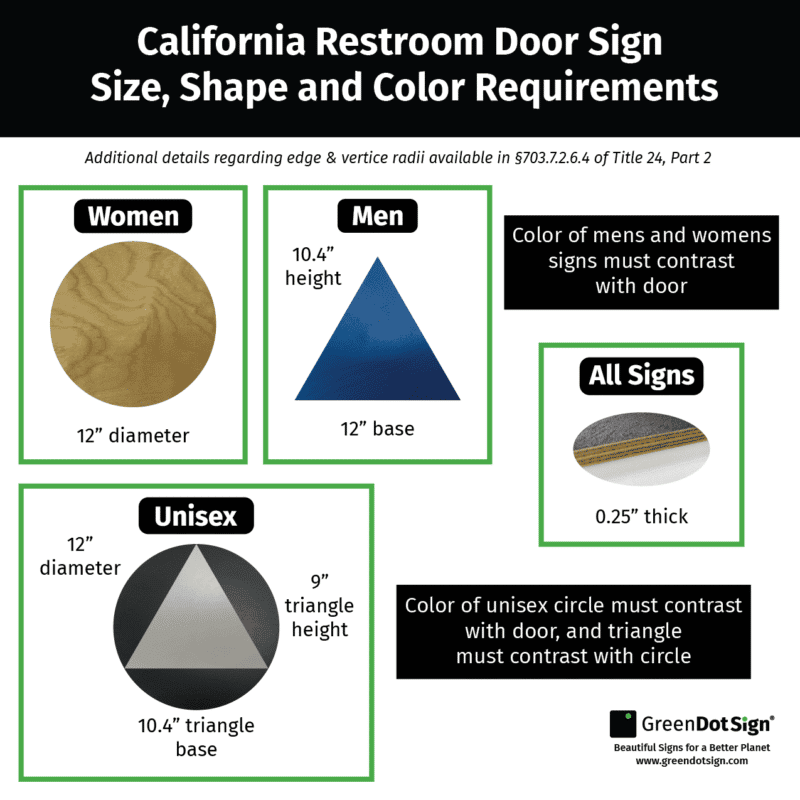
No, you are not required to put pictograms or wording on CA Title 24 geometric door signs. The signs’ triangle and circle symbols themselves indicate restroom gender.
However, there is one exceptional case in which the ISA is required. If you are using a dual purpose door sign, and not all restrooms in your building are handicapped accessible per the ADA, then the ISA must be used to mark accessible restrooms. In this situation, you must also post additional signs directing to accessible restrooms from the inaccessible bathrooms.
If you plan to use the modified ISA, which is the more active leaning-forward, handicap symbol, we recommend giving your inspector a call before ordering ADA signs. While the modified ISA is required in NY and CT, it’s not required in CA. The traditional ISA is the only federally recognized Symbol of Accessibility.